How I Document Artwork: The Carlson Method
I’m a painter and photographer, trained at the Pennsylvania Academy of the Fine Arts, and I run Carlson Art Photography as a one-person studio for artists, galleries and institutions. I know how much goes into a piece before it gets to me. This page is how I photograph it: the equipment, the order I work in, and the checks I run so the file matches the object in front of me. If you’re comparing studios, these are fair questions to ask any of them.
Why the method exists
The common failure in art photography isn’t a bad photograph. It’s an almost-right one. A red that has drifted toward orange, a corner half a stop darker than the center, a varnished surface flattened by glare. None of it is obvious on a phone. All of it shows up in a catalogue, a print, or on a juror’s screen.
I founded the studio in 2022, and my own work has been exhibited in New York, Philadelphia, Berlin, Carrara and Salt Lake City, so I’ve been on both sides of that file. The standard I hold every shoot to is simple to say and slow to do: the photograph is a faithful record of the work, and it’s consistent from the first piece in a set to the last.
Color, checked twice
Color is the one thing you can’t correct by eye, so I don’t try. Every lighting setup gets its own reference: a 48-patch Datacolor Spyder Checkr, photographed in the same plane as the artwork under the same lights. From it I build a profile that’s applied to every frame shot under that setup. White balance is set from the chart’s gray patch, never from the camera’s automatic setting, which drifts from frame to frame.
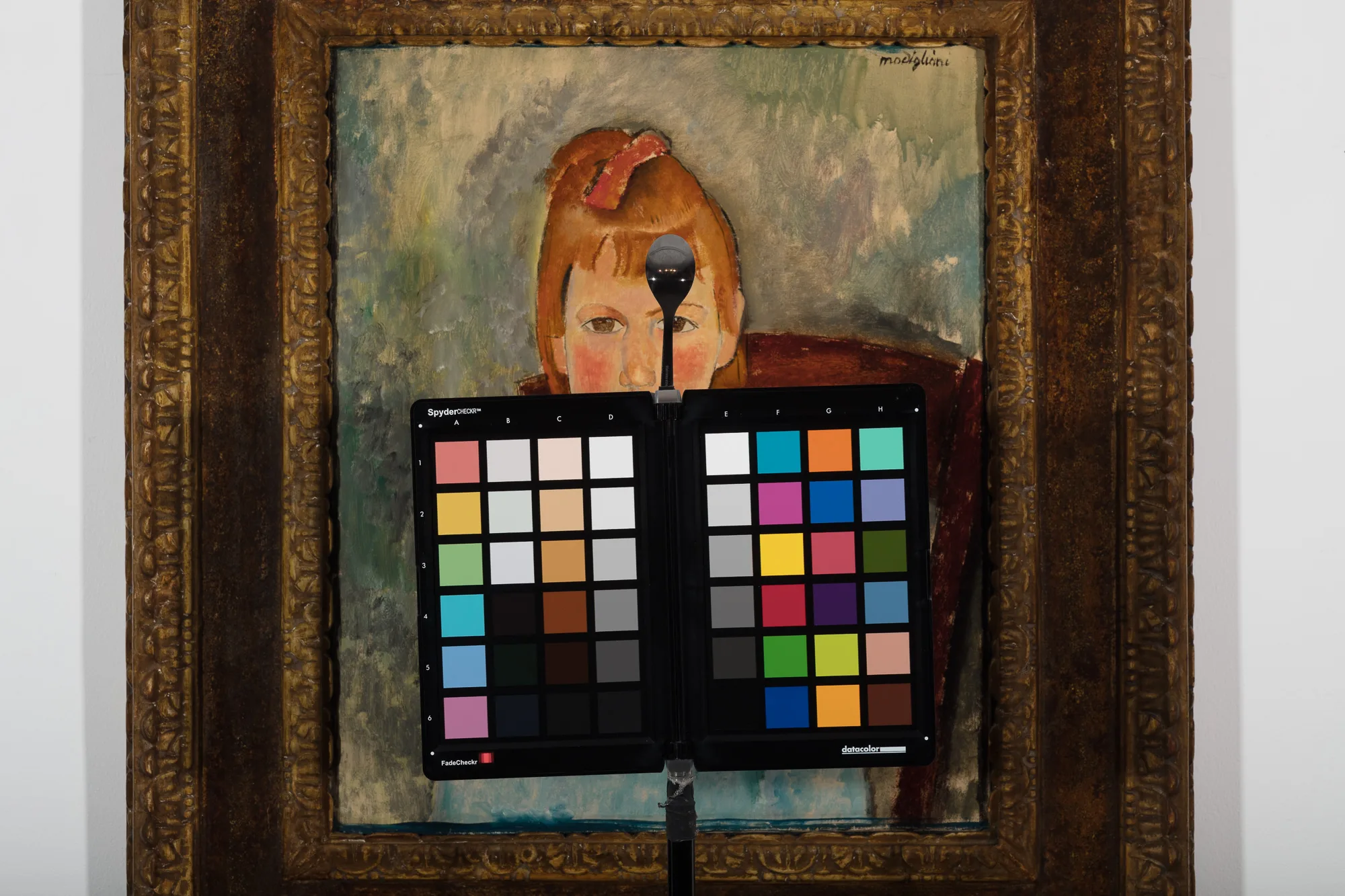
The second check is the screen I judge the files on. A correct file viewed on a display in the wrong mode still leads to wrong decisions, and that mistake leaves no trace in the file. You find out when a print comes back. Before I make any color judgment, I confirm the display is on its photography reference setting with the automatic color-shifting features switched off. It’s on my delivery checklist for that reason.
The camera and how I set it
I shoot on a Canon 5DS R, a 50.6-megapixel camera, with a Sigma 70mm macro lens for individual works. For flat work the settings don’t move: manual exposure, ISO 100, f/8, RAW files. f/8 is where that lens is sharpest. Stopping down further on a sensor this dense starts to soften the image, so I don’t.
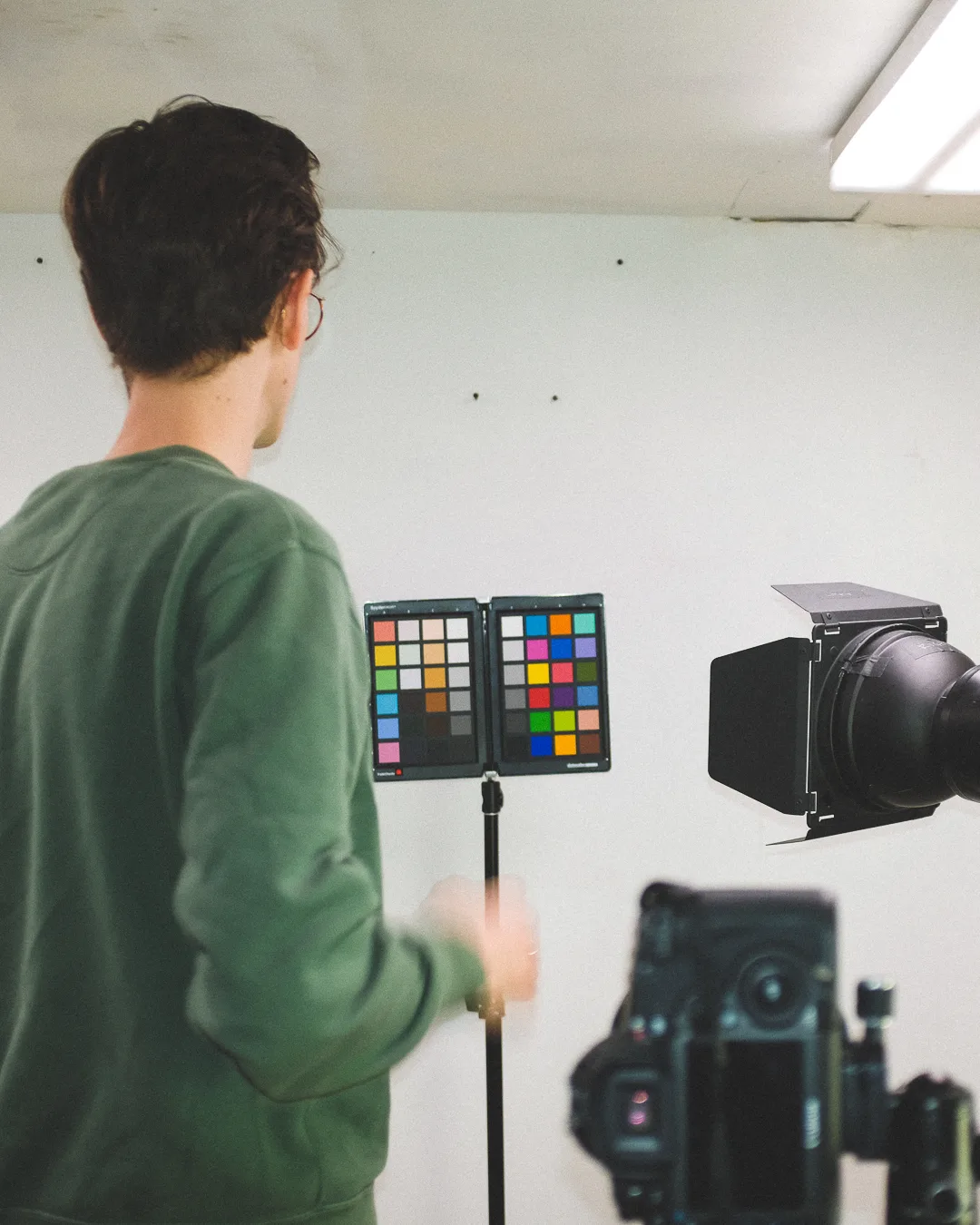
The camera is tethered to a laptop. I focus by hand on a brushstroke or the texture of the paper, magnified, and the shutter fires on a short timer or from the computer, so nothing touches the camera at the moment of exposure. At fifty megapixels, a fingertip of vibration shows. I check the first frame at 100% before I shoot the rest of the set; if it’s soft, I fix it there, not in post.
The camera sits square to the work, centered on it and level on both axes. A tilted camera turns a rectangle into a trapezoid. Software can straighten a little of that, but it’s better not to need it.
Even light, measured
Flat work is lit with two strobes at 45 degrees, matched in power and distance and raised to the center of the piece. I aim each one slightly past center so the stronger part of its beam lands on the far side of the work, which evens out the falloff across larger canvases. The room is dark. The only light on the piece is light I control, so its color is known and repeatable.
Then I measure it instead of trusting it. Before the artwork goes up, I photograph a blank gray board in its place and read the four corners and the center. They should land within about five levels of each other, roughly the uniformity the FADGI guidelines set for digitizing cultural heritage collections. If they don’t, I move the lights and shoot the board again.
Varnished oils, glossy surfaces and work under glass reflect the lights back into the lens. For those I use cross-polarized light, which removes the glare, and I shoot an unpolarized frame alongside it. Polarization can flatten heavy impasto, so you get to choose.
Sculpture and three-dimensional work
Objects are the opposite problem. A painting wants shadowless light; a sculpture needs shadow to show its form. Three-dimensional work takes more time: multiple angles, lighting set for each piece, and careful control of where the shadows fall. That’s why the per-piece rate is higher for sculpture, ceramics and mixed media.

In the studio or at your space
Most single works come to my studio in Harlem, by appointment, where the setup is permanent and turnaround is fastest. For installations, exhibitions, art fair booths and work that can’t travel, I come to you, anywhere in the five boroughs and the Tri-State area, with the same lights, the same chart and the same checklist. On location, the cards are backed up to two places before I leave the building.
Exhibitions and installation views
Photographing an installation is a different job from photographing a painting, and I don’t use the copy-work lighting for it. A gallery’s lighting is part of the show. The curator and the preparators made decisions, and my job is to record them, not override them. When the existing light is good, I photograph the room in it. When it’s dim or uneven, I lift the shadows with a single strobe bounced off the ceiling, one to two stops under the room light, so it fills without competing.
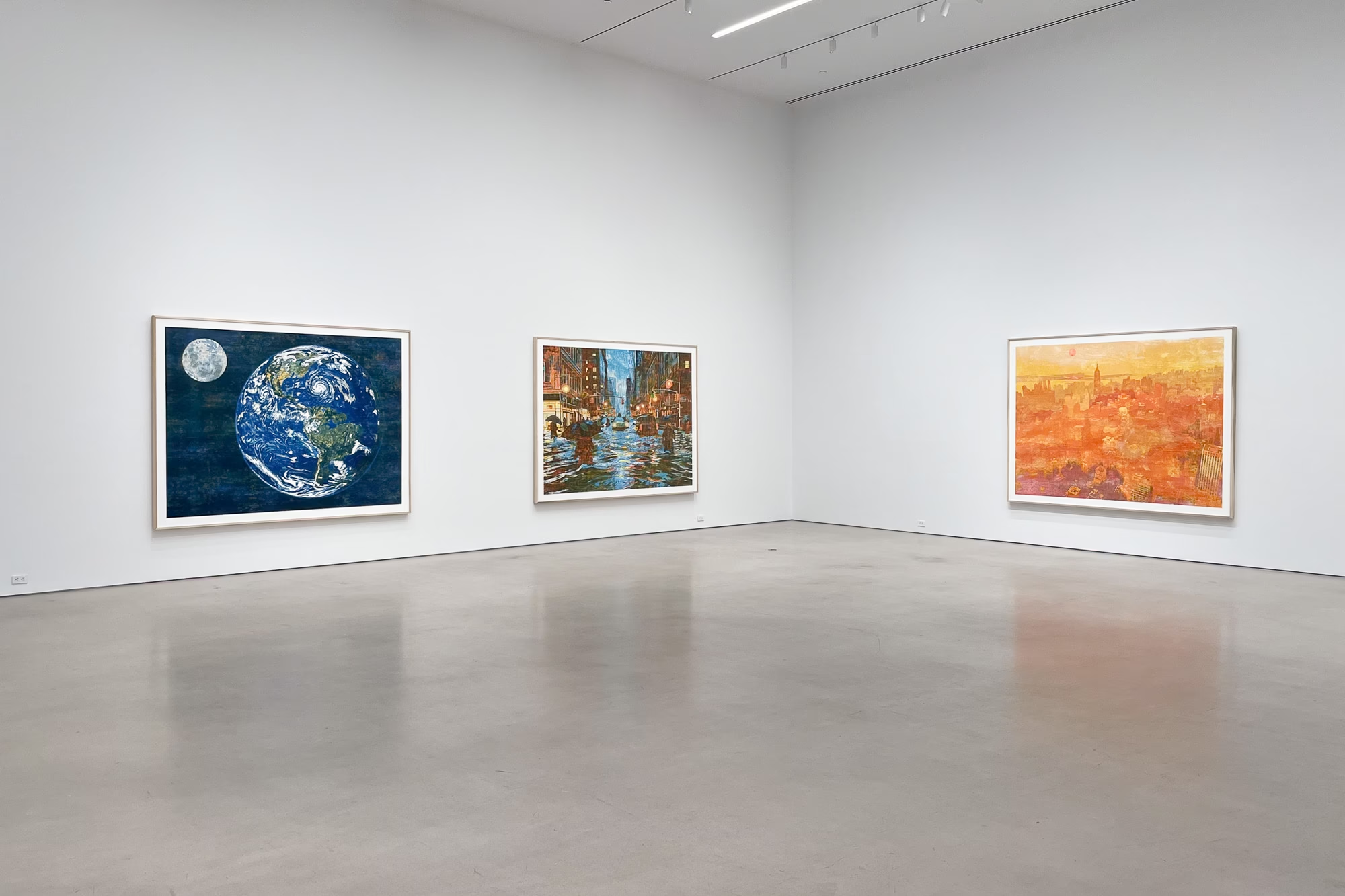
A typical session covers wide installation views that establish the show, three-quarter views that show how the works speak to each other, and individual pieces for press, archives and inventory. Most are shot the morning before an opening or right after the install. There’s more on how I work with galleries on the gallery documentation page.
Files and delivery
Every image is delivered in four versions: a 16-bit TIFF for the archive and for print, a full-resolution JPEG, a smaller JPEG for email and submissions, and one sized for Instagram. The bit depth matters more than it sounds: it keeps the smooth washes and gradients in a painting from breaking into bands. File names carry the piece, so the set matches your inventory without a key.
Files arrive by download link, usually within three to five business days, or within 48 hours on request. If you need prints from them, the same files go straight to archival pigment printing.
For submissions and portfolios
Most files I make are headed somewhere specific: a gallery submission, a grant, a residency, a juried show. Each has its own requirements for pixel dimensions, file size and color space, so I export to the spec instead of sending one generic file. If you’re preparing a submission, start with the guide to preparing artwork for gallery submissions. If you’re photographing your own work, how to photograph artwork for a portfolio covers what you can do yourself.
Cost and timing
Pricing is published: per piece for individual works, and by the half day or full day for exhibitions and installations, with travel inside New York City included in the day rates. Current numbers are on the pricing page, and the full service is described on the artwork documentation page.
Ready to document your work?
The studio is in Harlem, by appointment. Tell me what you have, how many pieces, and where the files are going, and I’ll tell you how I’d shoot them. Book a shoot, call (646) 484-8312, or email studio@carlsonartphotography.com.